Kassandra Strauss
04/29/2021
BIOL293
Scientific Literacy Assignment
Background Information
Out of the many organelles that are a part of cellular death, in algal cells the chloroplast and nucleus are two of the main factors besides mitochondria. Within some chloroplasts, pyrenoids are also an unknown, but still probable factor in apoptosis. The nucleus undergoes multiple steps in apoptosis from the nuclear membrane to the chromatin and DNA itself. The chromatin first condenses thus turning off the ability to replicate or transcribe. Next, small Caspase-Activated DNase begins to cut up the DNA into what looks like ladders making them unusable. Lastly, the nuclear membrane begins to bulge and break apart along with the cellular membrane (abcam, 2021). Chloroplasts, while not as known as mitochondria for apoptosis, are known to create reactive oxygen and release cytochrome f when in the presence of light while either being recruited or working alongside the algal mitochondria (Aken, O. V., Breusegem, F. V., 2015). The pyrenoid, a micro-organelle within some chloroplasts, creates CO2 for the chloroplasts which is believed to be of use in apoptosis, but it is unknown how it fully contributes (Wikipedia Contributors, 2021). Each of these organelles, and organelle within an organelle, holds some factor used for apoptosis when they are present within the cell undergoing so. Not all cells have some these organelles, however, thus those are not required unlike the mitochondria and nucleus which are present, except in cases of prokaryotes.
Some of the cells that have these organelles are specific species of related algae. One of such algal cells is the genus Pandorina. A small multicellular cluster of mobile green algae that consists of 8 to 32 cells. These cells are kept compact by an outer layer, move using flagella, and contain an eyespot per cell. Each cell also has a chloroplast with at least one pyrenoid. The presence of the pyrenoid indicates that this species lives in a larger body of water that loses CO2 saturation quickly (Wikipedia Contributors, 2021). While this genus contains pyrenoids, the genus Rhodochorton does not. Rhodochorton do have chloroplasts but they must be able to gain CO2 elsewhere. This genus is also multicellular and very filamentous along with being a red rather than green algae. These algal cells also have species that differentiate in location with some freshwater and others marine, but they all are found growing on rock surfaces (Wikipedia Contributors, 2020). A different freshwater only genus is Volvox, a colony living green algae. Each colony is up to 50,000 different types of cells that work together as a multicellular organism. Within a specific group of the cells, the ones used for energy rather than movement or reproduction, chloroplasts and pyrenoids are existent as the colony moves constantly towards light (Wikipedia Contributors, 2021). They move using many flagella, unlike the genus Chlorella which have none. This genus is single-celled and reproduces and thrives fairly easily and quickly with CO2, water, sunlight, and little nutrients. The chloroplasts these green algae contain have pyrenoids thus they aren’t reliant on outside sources of CO2. However, due to their ability to thrive in freshwater, CO2 isn’t always too much of a problem before overgrowth of algae occurs which takes advantage of all remaining CO2 leaving very little left (Wikipedia Contributors, 2021).
There are multiple differences between each genus as seen in the previous paragraph. Single-celled creatures came before multicellular ones in the evolutionary chain, but there is also a difference in types of algae color or chloroplast types thus it is possible that the multicellular genetic mutated twice in different lines. The first split from a single-cell ancestor was one genus that became red algae while the other green. The red line later mutated into becoming multicellular leading to Rhodochorton. On the green algae line, a split occurred between genus that stayed single-cellular leading to Chlorella, and genus that mutated into becoming multicellular. The multicellular ancestor eventually split again into one with just a chloroplast, Volvox, and genus that evolved a compartment in the Chloroplast called the pyrenoid which leads to the genus Pandorina.
Major Findings
In the study of Experimental taphonomy of organelles and the fossil record of early eukaryotic evolution (Carlisle, E. M., Jobbins M., Pankhania, V., Cunningham, J. A., and Donoghue, P. C. J., 2021) the experiment was used to discover and test whether fossilized early eukaryotic cells broke down too fast to be accurately studied or if they could have decayed slow enough that they can be studied accurately. To do this they tested living algae decay processes from multiple sources, fresh vs salt water, and of differing colony/singular features. Each algae cell and colony were already grown and bought from Sciento.co.uk before they were tested. Each type was placed in water simulating their natural environment, and then euthanized using a solution of beta-mercaptoethanol which kept outside toxic chemicals from affecting the decaying process to allow for the cells to decay on their own without interference. (The Free Dictionary Contributors, 2021)
As the cells died, they were studied to show the eventual affects every few days. The main affects studied was the presence of a nucleus, holes and/or thinning of the chloroplasts or even its collapse, whether the green algae’s pyrenoids were visible, and whether the cell itself has collapsed yet. Each cell type also had an ongoing test of how they reacted in conditions of present or absent oxygen levels in the water. For each cell type, the oxygen did not change the ordered pattern of what breaks down first per cell type, however, some individual processes took either slightly longer or sometimes slightly faster for chloroplast holes and collapse respectfully. Besides the slight speed differences, each species held a pattern of decay.
In Volvox aureus, the first was a rapid loss of pyrenoids and then steady nucleus loss followed by a slightly steady growth in breaking chloroplasts. Pandorina morum, however, started with a very quick cell collapse, loss of the nucleus, and loss of pyrenoids followed by a steady growth of holes and thinning of the released chloroplasts. Chlorella, like Volvox aureus, contained no cellular collapse but started with an increase of nucleus visibility before it began to drop while chloroplast holes steadily climbed after pyrenoids lost visibility. Akin to Pandorina morum, Rhodochorton undergoes cell collapse, but only after loss of nucleus visibility and during the fairly slow growth of holes in the chloroplast.
Besides the charts, pictures were taken alongside the decay process of individual and colony species alike. For the colony of V. aureus, what started as a membrane bound hunch of cells began to scatter by day 7 along with the slow breakdown of cellular components and some cell shapes. On day 19, some nucleus began to escape individual cells, and by day 31 and 34, other components such as chloroplasts and pyrenoids began to break out and apart as the cells ruptured. The green mini colony of algae P. morum started by day 3 to break apart into respectful cells then by day 10, the cells themselves began to bubble as organelles began escaping. At day 12, larger organelles such as the decaying chloroplast and pyrenoids escaped. Then by day 17 each organelle was separated and the pyrenoids had decayed. The single cell Chlorella sp. Started with the organelles seemingly huddling to one side of the cell after death and by day 7 the cellular membrane began to deform as organelles began to escape. Day 10 showed the loss of broken chloroplasts from ruptured cells and already lost pyrenoids. By day 21 pyrenoids were gone while chloroplasts were either in cells that were breaking apart or had already escaped and was breaking down. By day 45 many chloroplasts seemed free and cellular membranes left were bubbled. Unlike the previous green algae, the fibrous red algae Rhodochorton sp. started off seemingly swelling as organelles collected at the sides then by day 19 chloroplasts seemed fine but other cellular components were breaking apart. At day 27 the chloroplast began to break, and by day 31 some cells were close to rupturing the breaking down organelles.
After the tests of the eventual decay of which showed that the nuclei can survive long enough to be properly fossilized, the cells of ancient organelles were studied. Some had very apparent nuclei or a possible ancient ancestor to the modern nuclei and a large chloroplast in some that could also possibly be a nucleus. Other possibilities are broken down organelles that had already undergone decay before fully fossilizing. Based on the previous tests, it is possible that what is seen can be a nucleus due to their longevity through decay, and some chloroplasts also can at times exist longer than others through the decay process, but other organelles might not be apparent as they had already been broken down by the time it would take to fossilize.
References
abcam employees (2021). Nuclear condensation, DNA fragmentation and membrane disruption during apoptosis. abcam, https://www.abcam.com/kits/nuclear-condensation-dna-fragmentation-and-membrane-disruption-during-apoptosis
Aken, O. V., Breusegem, F. V. (2015). Licensed to kill: mitochondria, chloroplasts, and cell death. Trends in Plant Science 20, 754-766.
Carlisle, E. M., Jobbins M., Pankhania, V., Cunningham, J. A., and Donoghue, P. C. J. (2021). Experimental taphonomy of organelles and the fossil record of early eukaryote evolution. Science Advances 7, 10.1126.
The Free Dictionary contributors. (2021). Autolysis, https://medical-dictionary.thefreedictionary.com/autolysis
Wikipedia contributors. (2021a). Pyrenoid, https://en.wikipedia.org/wiki/Pyrenoid
Wikipedia contributors. (2021b). Pandorina, https://en.wikipedia.org/wiki/Pandorina
Wikipedia contributors. (2020). Rhodochorton, https://en.wikipedia.org/wiki/Rhodochorton
Wikipedia contributors. (2021c). Volvox, https://en.wikipedia.org/wiki/Volvox
Wikipedia contributors. 2021d). Chlorella, https://en.wikipedia.org/wiki/Chlorella
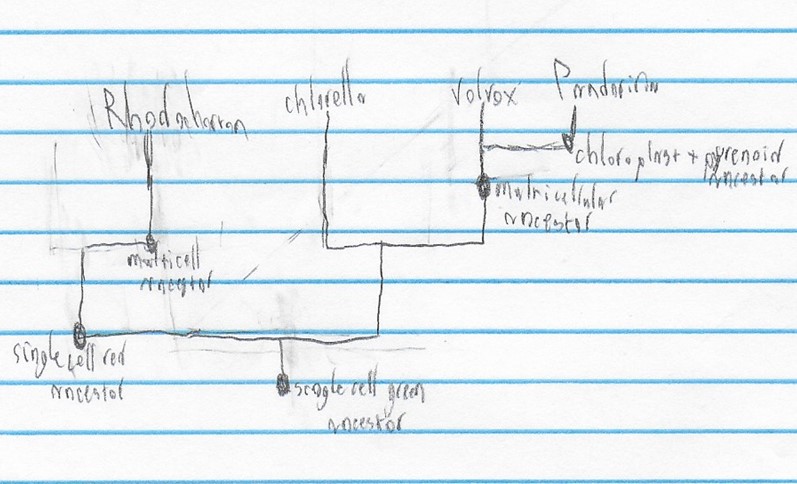
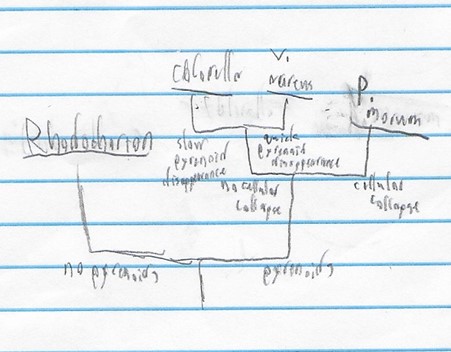
| In the 2nd phylogenetic tree Rhodochorton is singled out for having pyrenoids while the others do. Then Pandorina is singled out for decaying with cellular collapse and Chlorella and Volvox have the closest common ancestors. In the 1st phylogenetic tree, however, Volvox and Pandorina had the closest common ancestors due to both being multicellular. Next, they had a similar ancestor with Chlorella, and lastly, they were one with the ancestor of Rhodochorton very long ago, similar to the 2nd tree. |
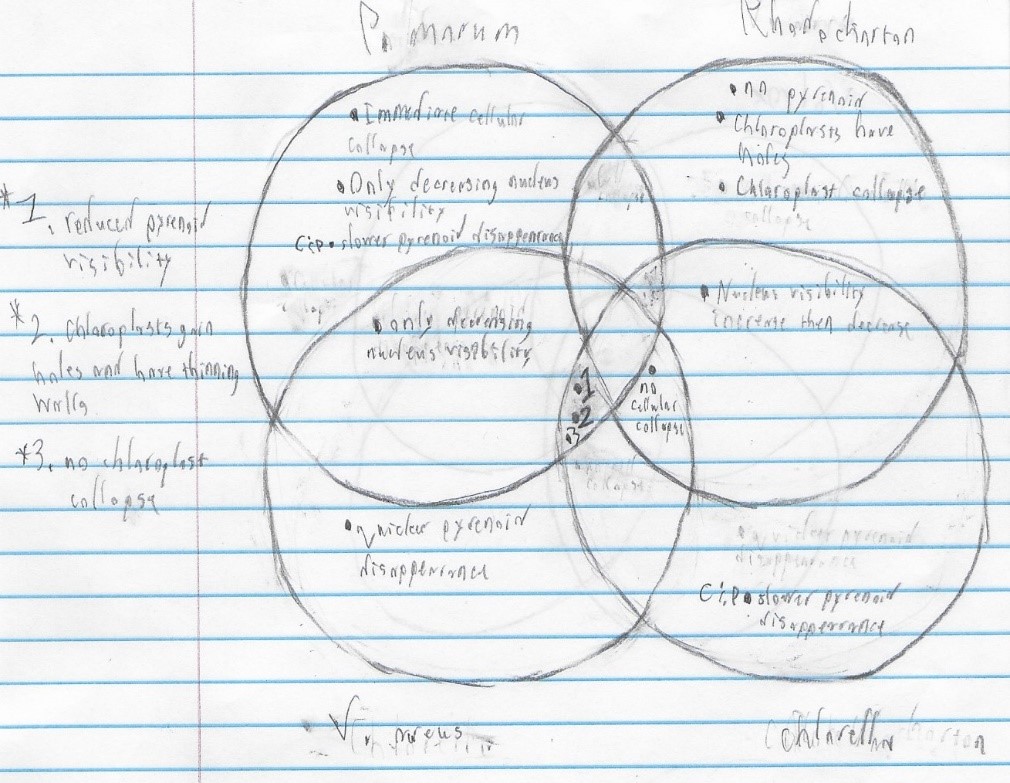
 Tree-Glass